

An API that seemed stable in staging can stall as soon as it serves both a React SPA and a mobile app. One client overfetches, another requests five endpoints per page load, and the next feature request causes route sprawl. Soon, a significant portion of the sprint is devoted to resolving contract mismatches instead of delivering features. This pattern shows why we need to move beyond REST. GraphQL, tRPC, and Next.js server actions provide alternatives that better fit modern architectures.
Why REST is not enough for modern apps
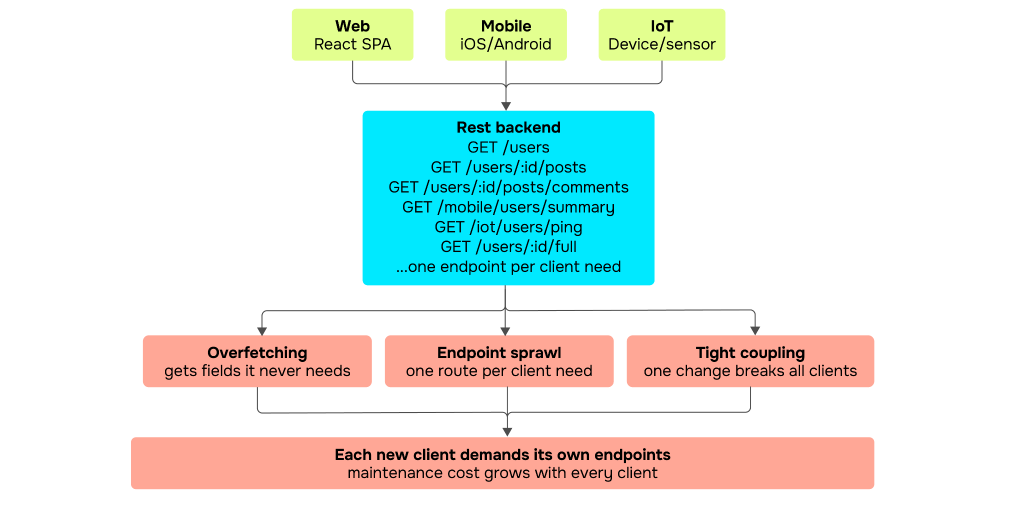
REST’s appeal remains its simplicity: model resources, map them to URLs, use HTTP verbs, and let the stack handle the rest. This model suited earlier web development when interfaces reflected the backend, and data needs were consistent. However, the rise of SPAs, mobile clients, and real-time dashboards changed these assumptions.
Current frontends require tailored, dynamic data. For instance, a React SPA page might need a post, its comments, and selected fields from each author. With REST, this usually results in overfetching (retrieving all data when only a subset is needed) or underfetching, which then necessitates multiple network requests for related entities. This drives developers to compare GraphQL vs. REST for modern web development, especially when data needs are complex or variable.
Watch out: Overfetching slows mobile load times and drains battery life as data shapes become more complex.
Each new client, whether web, mobile, or IoT, requires slightly different endpoints or query parameters. As a result, endpoint sprawl raises maintenance costs and complicates versioning. Rigid URL-resource associations mean changes in backend data or structure can disrupt several clients simultaneously, hindering feature delivery.
REST’s resource-focused constraints can limit key requirements such as aggregation across entities, advanced filtering, or providing partial data for privacy. PATCH endpoints multiply, URL patterns become inconsistent, and predictability erodes over time.
Note: For more on REST’s origins, see the original Roy Fielding dissertation.
GraphQL arose to resolve problems of client-centric data shaping and enforceable contracts. It shifts the API focus from fixed resources to a schema and supports flexible data selection. For those evaluating frameworks such as GraphQL, tRPC, and REST, this philosophical shift is essential.
Consider where REST APIs reach their limits.
How GraphQL changes data modeling
GraphQL eliminates REST’s mapping between routes and resources, replacing it with a typed schema that describes entities and relationships. Clients specify the data shape they require by traversing the schema graph. Each query retrieves fields and nested data structures, always with strong typing and introspection. This forms the backbone of GraphQL API architecture and guides the continuing comparison of GraphQL vs. tRPC for scalable APIs and type safety.
The schema serves as an intent contract. Any client, web, mobile, CLI, or third party can inspect available data, fields, and type connections. This self-documenting characteristic accelerates development and reduces documentation errors. REST contracts tend to break at runtime, but GraphQL’s static schema and centralized validation provide early feedback for both producers and consumers.
Practical tip: Strongly typed schemas can be introspected to generate client code. See Apollo’s tools. For guided practice, refer to Educative’s GraphQL resources. For best practices in GraphQL API design, prioritize schema clarity and automated code generation.
GraphQL queries move through the schema graph. Clients specify each necessary field and subfield, which reduces both overfetch and unnecessary cascade requests. This pattern supports multi-platform development and evolving monoliths. When comparing GraphQL and tRPC, query flexibility is a core distinction.
This flexibility introduces operational challenges.
First, the N+1 query problem can occur: each nested field may require a separate database query per object, per layer. Next, schema federation lets organizations distribute the schema among teams, but merging these pieces can complicate build cycles. Caching is less intuitive than with REST, as HTTP caching is poorly suited to GraphQL queries. Instead, teams often rely on normalized caches or persistent query layers.
GraphQL security requires active management. Schema introspection can expose sensitive operations and fields. Protect public APIs by restricting the schema, enforcing field-level authorization, and imposing query complexity and depth limits with middleware such as graphql-shield.
While GraphQL facilitates central contracts and flexible data selection, it entails operational trade-offs. Supporting rapid iteration across many clients means accepting a higher setup cost and greater maintenance complexity.
Concrete examples illustrate GraphQL’s benefits. One fintech team using federation supported concurrent feature delivery on web and mobile clients, reducing contract breakage and delivering features more rapidly.
This data modeling approach is apparent in real request flows. The contrast between REST and GraphQL is most evident in multi-entity fetch scenarios, motivating many teams to re-examine when to use each.
Here is how granular data access shifts from REST to GraphQL.
Comparison of nested data fetching via REST (multiple endpoints) vs GraphQL (single query) with data flow comments
tRPC adopts a different approach. Rather than centering on a global contract, it enables direct, type-safe procedure calls that integrate with TypeScript, an increasingly popular pattern in Next.js API development.
Where tRPC fits in full-stack TypeScript teams
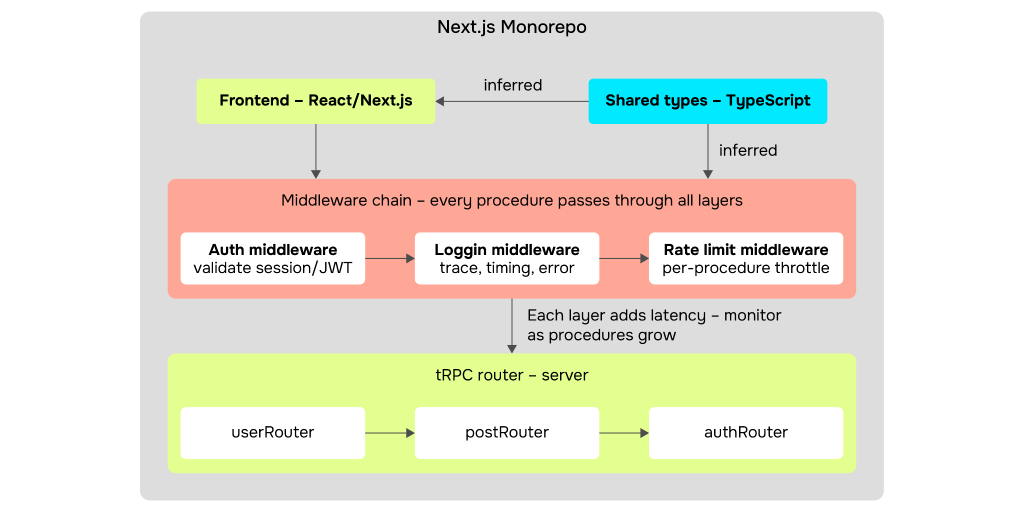
tRPC’s aim is clear: combine frontend and backend using end-to-end type safety. In a TypeScript monorepo, procedure contracts derive directly from shared code. This removes the risk of serialization errors or data mismatches common in REST or GraphQL, and offers a type-safe API development process valued by teams adopting the tRPC API framework in mono-repos.
Code generation, HTTP resource mapping, and manual schema maintenance are unnecessary. The server defines routers (procedure groups), and the client invokes them as strongly typed functions. These features drive frequent debates about tRPC vs. REST among TypeScript developers.
This approach yields a consistent developer experience:
- Auto-complete everywhere. Shared type inference between client and server provides immediate IDE feedback.
- Zero serialization gap. Inputs, outputs, and errors correspond to precise TypeScript types. Refactorings propagate instantly across the stack.
- No manual schema drift. OpenAPI, Swagger, and GraphQL introspection become unnecessary. Contracts are enforced at compile time, enabling type-safe APIs with tRPC from day one.
Note: See the tRPC docs for practical router and middleware patterns. For those creating type-safe APIs with tRPC, these patterns form a foundation.
However, these benefits come with limitations.
tRPC binds closely to TypeScript. There is no direct path for clients in other languages, such as Swift, Java, or Go. It is best suited to monorepo setups where full stack ownership is possible, for example, Next.js/TypeScript mono-apps. tRPC integration with Next.js is common in TypeScript-intensive teams, but extending support to other languages is not straightforward. Middleware should be carefully managed, as every procedure passes through each middleware layer. Unmonitored growth in middleware or procedures can cause performance issues at scale.
Enforcing type-level safety requires initial investment. Wrapping logic with Zod or Joi validation raises up-front effort but prevents data shape errors before runtime. In practice, this reduces contract mismatch bugs by up to 80 percent for some internal tools, evidence supporting the benefits of tRPC over REST in TypeScript projects.
Watch out: Exclusive reliance on type safety can create team silos. For projects with both TypeScript and non-TypeScript clients, tRPC does not scale, an important point when weighing tRPC vs. GraphQL for full-stack development or microservices.
This productivity–constraint combination highlights tRPC’s architectural sweet spot. Before reviewing team structure, examine how tRPC aligns routers to client calls.
Why team structure and client diversity matter
Choosing an API architecture depends not only on technical elements but also on product scope and team organization.
Small, full-stack TypeScript teams developing internal dashboards or SaaS MVPs benefit most from tRPC’s immediate, type-driven feedback. A unified codebase removes the need for data translation or code generation pipelines.
Enterprise organizations present different requirements:
- Multiple teams must deliver features simultaneously.
- Public APIs must support third-party apps, mobile devices, and partners using various languages.
- The roadmap requires schema or entity evolution without coordinated deployments.
In these cases, GraphQL’s federated schema and language-agnostic design enable parallel innovation. A central schema contract preserves system stability, while individual teams can advance independently. For example, a group may add a field needed for their users without affecting others, a clear advantage in the GraphQL vs. tRPC comparison for scalable APIs and team autonomy.
Practical tip: Select your API technology to fit your organization and client mix. Later maintenance or onboarding costs, rather than initial implementation speed, usually determine the true impact.
Some use cases require only simplicity. Static sites and CRUD admin panels typically do not justify the operational complexity of GraphQL or tRPC. In these cases, direct invocation models such as server actions in Next.js offer faster development cycles.
To clarify these trade-offs, use this scenario-driven comparison as a reference when evaluating GraphQL vs. tRPC for different teams and clients.
Decision Matrix: Mapping Project Characteristics to API Patterns and Trade-offs
| API Pattern | Project Scale | Client Diversity | Required Team Skillset | Pros | Cons |
| Direct API Integration | Small to Medium | Low (1–2 clients) | High API familiarity | Simple; minimal overhead | High maintenance; scaling issues |
| Backend-for-Frontend (BFF) | Medium to Large | High (diverse clients) | Client-specific backend development skills | Optimized payloads; better performance | Code duplication; increased effort |
| API Aggregation (GraphQL) | Large | High (complex client requirements) | Schema and query optimization proficiency | Fewer round trips; flexible data retrieval | Complex logic; performance bottlenecks possible |
| Service Mesh (Sidecar) | Large, polyglot microservices | High (internal services) | Expertise in service mesh & operational policies | Centralized management; enhanced observability | High operational overhead; steep learning curve |
| Unified API | Large (many integrations) | High (10–100+ integrations) | Building scalable API products | Simplified integration; lower maintenance | Over-generalization; lacks client specificity |
| Agent-to-Agent (A2A) | Advanced research | Not applicable | Multi-agent system and protocol expertise | Supports decentralized/complex agent systems | Very high maintenance; complex governance |
When to use server actions in Next.js projects
Server actions change backend logic execution in Next.js. Rather than managing API routes and manually parsing fetch requests, a developer invokes a server function directly from forms or UI events, eliminating routing boilerplate and manual parsing. For developers in Next.js API development, server actions streamline UI-centric logic and quick data submissions.
Example uses include submitting a contact form or updating a field in isolation. This model works best for targeted updates, internal tools without public APIs, and server-rendered dashboards. Server actions API integration lets teams establish backend interactions directly within frontend code.
Validation, authentication, and error handling coexist in the function. There is no need to maintain HTTP endpoints or manage redundant parsers. The framework handles serialization and anti-CSRF protection, bringing operational simplicity to server actions within Next.js.
Watch out: Server actions are strictly tied to Next.js and the server bundle. If logic must be accessed by non-Next.js clients or turned into a public API, a migration will be required. This difference is important when comparing server actions vs. tRPC for extensibility.
Server actions favor simplicity over broad applicability. Logic cannot be reused outside Next.js. Migrating to a public endpoint means rewriting logic. Routing is absent; developers call functions directly rather than targeting endpoints.
Review how developer workflows shift from classic API routes to server actions, especially in the context of server actions vs. REST or GraphQL APIs.
Comparison of pre-Server Action API route versus type-safe Server Action in Next.js
Key technical trade-offs and integration challenges
With usage patterns established, consider where each architecture can fail under scale or operational constraints, key issues when comparing GraphQL vs. tRPC benchmarks, or seeking best practices for choosing an API framework.
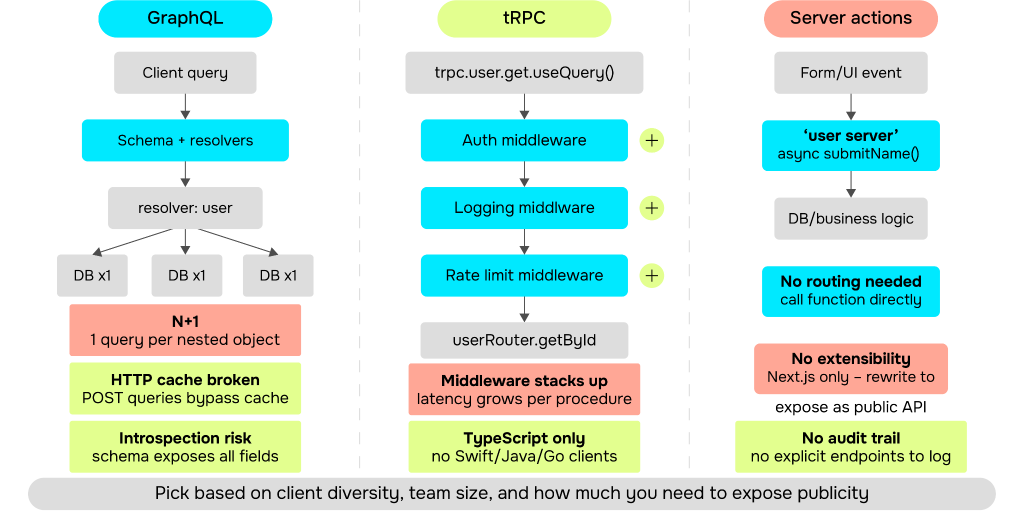
GraphQL
- N+1 queries: Each nested resolver may initiate additional database calls. Use batching or DataLoader to maintain acceptable performance. If evaluating GraphQL vs. tRPC for real-time scenarios, addressing N+1 queries is critical.
- Caching: Flexible query shapes break HTTP caching. Use field-level caches or persistent query maps rather than relying solely on HTTP caching.
- Introspection risk: Exposing the full schema may leak sensitive data. Apply field-level authorization and query depth limits. Use middleware such as graphql-shield for mitigation.
- Schema changes: Federated contract migration across teams can slow project delivery, even if long-term system stability improves.
tRPC
- TypeScript dependency: Supporting non-TypeScript clients, such as Flutter mobile apps or Java microservices, requires maintaining duplicate logic, a key point in tRPC vs. GraphQL debates around multi-language support.
- Scaling monoliths: A rising number of procedures increases reliance on shared middleware, which, without profiling, can degrade performance. Monitor and optimize middleware, especially when comparing server actions vs. tRPC for API traffic.
- Bundle size: Shared types and use of Zod or Joi may cause frontend bundle inflation if not isolated and managed.
Server actions
- Limited extensibility: No straightforward route to REST or GraphQL. Exposing logic to public clients later requires a rewrite, a central issue in server actions vs. tRPC debates around server-side rendering.
- Reduced visibility: Standard request logging and audit trails may be diminished because explicit endpoints are absent.
- Error handling: Custom serialization is necessary to surface errors outside server-rendered views.
Note: For a detailed walk-through of these edge cases, refer to
Some illustrative scenarios:
- One team sees contract mismatch bugs fall by 80 percent using tRPC for a dashboard, but must duplicate logic for an Android app introduced later.
- A GraphQL API adds one nested resolver per entity; without DataLoader, nested queries grow from 300 ms to 3 seconds as database calls multiply. In contrast, GraphQL federation can speed up feature delivery for web and mobile clients, reinforcing the GraphQL vs. tRPC distinction for scalable APIs.
- An attempt to extend a server action for a Slack integration fails, requiring a rewrite to REST or GraphQL and increasing cost.
Practical tip: Pilot new architectures using real features that test system limitations. Do not rely solely on simple CRUD demonstrations. When choosing between GraphQL and tRPC, or deciding between server actions and tRPC in Next.js, validate with your most demanding use case.
To clarify where bottlenecks and integration issues appear, analyze these placements within the runtime architecture.
Choosing the right approach for your project
No single technology fits every case. The most suitable API design depends on your project size, your team’s expertise, and your client mix. For questions such as “What are the differences between GraphQL and tRPC?” or “How do server actions work in Next.js?”, anchoring the choice to concrete use cases and your team’s profile is essential.
Begin with these considerations:
- Which clients will use your API? Is it solely web, or will mobile, partner, and third-party clients access it?
- Does your architecture require fine-grained, flexible, or network-efficient data selection?
- Is your team fully invested in TypeScript, or are there unavoidable multi-language needs?
- Is the tool bounded in scope, or must it evolve and scale over time?
A practical progression:
- For personal tools or small, internal dashboards, server actions are optimal for their simplicity and minimal overhead.
- For large SaaS products or public APIs, GraphQL offers schema contracts, supports diverse clients, and enables federation for parallel team delivery, making it the default for GraphQL vs. tRPC in cross-platform scenarios.
- For full stack TypeScript monorepos serving internal consumers, tRPC enables rapid iteration and type safety, supporting its case over REST in controlled environments.
Watch out: Choose the least complex solution that suffices. Too much abstraction slows small teams, while insufficient planning leads to debt as client diversity grows.
Match your API architecture to actual team delivery needs, not prevailing trends. Pay attention to requirements such as error monitoring, onboarding, and version control when making architecture decisions.
Practical tip: Before adopting a framework, prototype your hardest edge case. Validate functions like mobile client integration or schema federation before progressing with a new pattern.
Verification steps before committing to an API model:
- Can all required clients (web, mobile, partner) consume your API without duplication?
- Will schema, type, or data changes propagate safely and quickly?
- Is the team prepared for required maintenance (monitoring, caches, error management)?
- Does this approach cover both current and foreseeable future needs?
- Will contract evolution or cross-team collaboration limit progress?
- Have you reviewed real-world metrics (bug rates, delivery times, incidents) from teams with similar architectures?
For more information on Next.js server actions, you can have a look at our course “Building Full Stack Web Applications with Next.js.”
Conclusion
REST remains effective for small and uniform web projects, but modern systems require careful decisions about flexibility, maintainability, and team compatibility. When comparing GraphQL vs. tRPC, the choice depends on scale, structure, and client mix. GraphQL delivers precise, client-driven data access but introduces operational workload. tRPC supports fast TypeScript development for mono-stack teams, while server actions favor ergonomic, direct logic with the trade-off of tight coupling and limited reach in Next.js API design.
The essential lesson: align your API model to client needs and team patterns instead of short-term simplicity. Address risks, such as N+1 queries, type inconsistencies, or bundle growth, as early as possible. Always start by prototyping your most demanding case. Allow expected constraints to influence your choice, especially when comparing GraphQL, tRPC, and server actions in Next.js for API development.